Beyond Sustainability: A Visual Framework for Ecological Civilization
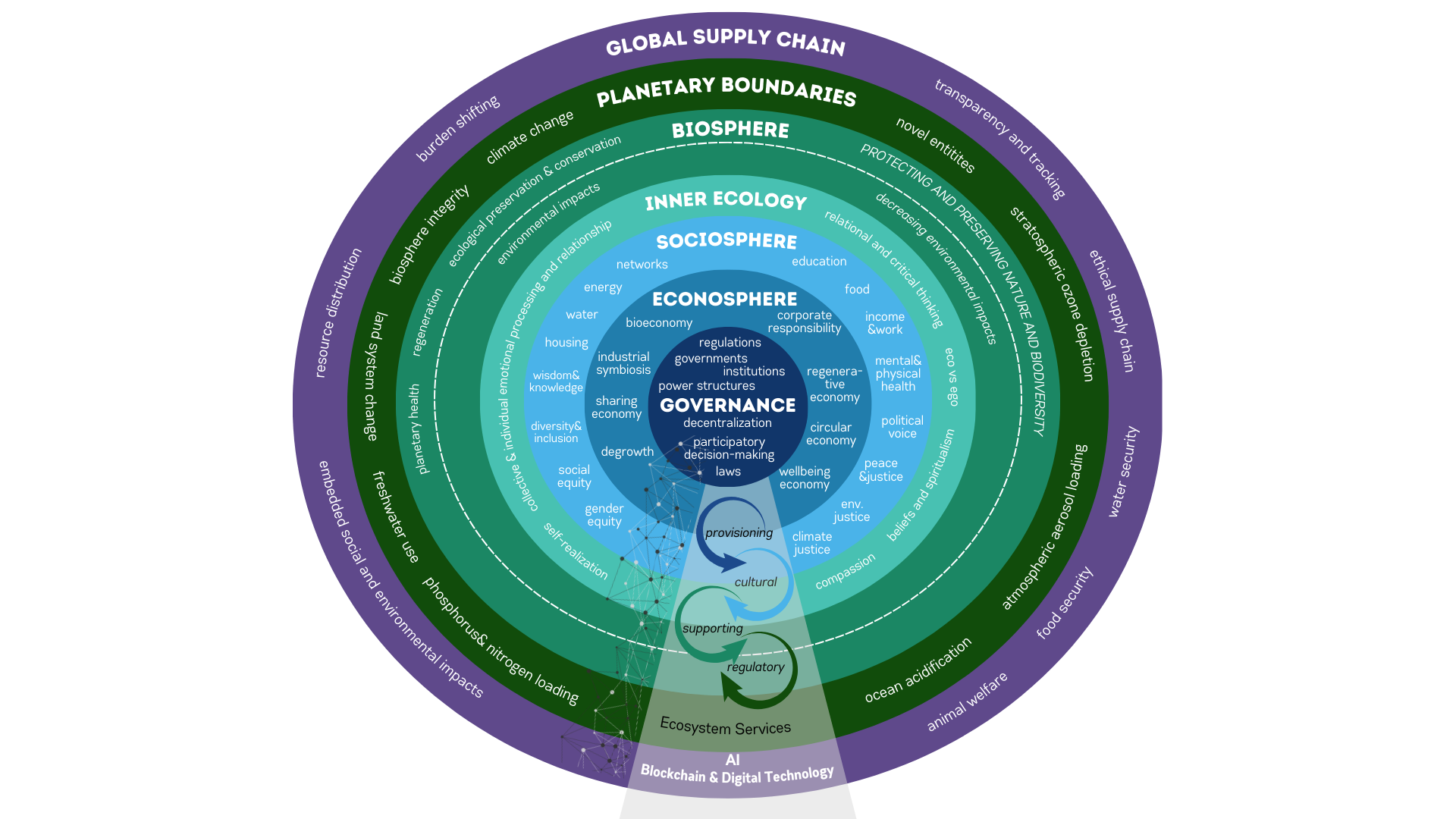
Teigiserova, D.A. 2025. Ecological Civilization for Planetary Sustainability Model. DOI: 10.5281/zenodo.15425107
“We cannot solve our problems with the same thinking we used when we created them.” Albert Einstein
But what if it’s not just our thinking that needs to change, but our entire way of being?
Throughout my years in academia, I have often found myself in a very transdisciplinary position where the combination and integration of many fields and disciplines was required. I am a visual thinker, but something was always lacking for me…I wanted to capture more, integrate more, connect more, bridge fields, and capture more nuance. The model I am sharing with you now is the culmination of that journey. It is not perfect. It is not meant to be. This is version 1.0, an ongoing and dynamic work. It’s the part of my upcoming book, but it’s also much more: an invitation to rethink our assumptions, to reconnect the fractured pieces of our world, and to prepare fertile ground for the collective transformations we need. We are not just facing ecological collapse, social division, and institutional breakdown; we are also experiencing a crisis of meaning, relationality, and inner disconnection. In response, this framework offers a new map to help us co-create, connect, and co-evolve.
So what is it about?
We live in a time where even the most advanced models often fall short of the complexity and interdependence we are experiencing globally. Many of them remain embedded in the same mindset of external problem-solving, driven by optimization and metrics while sidestepping the deeper relational, psychological, and cultural architectures that generate systemic dysfunction in the first place. They don’t sufficiently address the inner architecture that produces the problems in the first place.
What if we are treating systemic symptoms without addressing the cultural and psychological roots that sustain them? Can we achieve sustainability without also cultivating wisdom by connecting the inner transformation and external systems?
This framework doesn’t replace existing tools. Instead, it situates them in a broader context. It aims to reveal relationships—between disciplines, domains, and dimensions of life—so that we can move from fragmentation to coherence, from silos to systems, from sustainability to regeneration.
The model is composed of seven interdependent spheres that represent different dimensions of life. These are not silos but living systems — constantly shaping and being shaped by one another.
Governance – the formal and informal power structures that shape collective action and institutional behavior.
Econosphere – the economic environment, systems of value creation, innovation, infrastructure, and production.
Sociosphere – the social fabric: health systems, education, justice, equity, culture, and community.
Inner Ecology – the invisible architecture of identity, worldview, emotion, and consciousness.
Biosphere – the living ecosystems that sustain all life on Earth.
Planetary Boundaries – the ecological thresholds that define the safe operating space for humanity.
Global Supply Chain – the distributed, transboundary flows of resources, energy, labor, and hidden costs
Threaded through all these spheres are two additional dimensions: ecosystem services (provision – resources upon which economies are build, culture – the cornerstone of society, supporting and regulatory – the invisible services of nature that sustains us); and AI systems, which I see not merely as tools, but as co-evolutionary agents that are beginning to influence the structure and direction of many spheres—particularly cognition, labor, infrastructure, and even identity.
From Models to Meanings: How This Framework Emerged
This framework has many roots. I began with the Strong Sustainability model (adapting econosphere, sociosphere, biosphere approach) where ecological integrity is non-substitutable. Then I wove in Doughnut Economics, which articulates a just space for humanity between social foundations and Planetary boundaries.
But I wanted to go further.
I wanted to distinguish not only between social and ecological ceilings, but between types of ecological action. Most environmental metrics focus on reducing negative impact, which is necessary, but insufficient. Environmental sustainability requires the restoration and regeneration of natural capital. We must go beyond harm-reduction and make regeneration a key component of any human activity (and particularly our economies) and not an addition or nice-to-have.
From there, I began layering in insights from health equity, indigenous knowledge systems, trauma-informed science, degrowth economics, and participatory governance. I wanted to honor distinctions like:
Physical and mental health (not just “health” generically)
Climate and environmental justice (not just climate mitigation)
Wisdom and plural epistemologies (not just Western education systems)
Diversity and neurodivergence (as essential to resilience, not exceptions to norms)
The addition of diversity and inclusion was inspired by our views on the loss of biodiversity. Ecologists (and others) often recognize the detrimental consequences of the loss of biodiversity, which pushes the global ecosystems closer to tipping points. Similarly, our systems have pathologized differences in people and pushed us towards uniformity. But neuroscience shows us that neurodivergence, gender, cultural background, and other diversity factors are crucial for solving problems. Instead of recognizing our uniqueness and embracing it as part of the solution, we have pushed certain people to the outskirts and killed our ability to stay unique (up to the point of trauma). Healing our collective systems will require embracing the intelligence of difference.
The econosphere and governance elements follow the main fields and structural parts emerging and existing in our current structure, such as participatory decision-making, corporate responsibility, circular economy, degrowth, and more. The examples I included in the model are some of the leading – but not only – strategies and elements.
Among all the spheres, the global supply chain is placed in the outermost circle. Why? Because it is the ultimate vector of interconnection and disconnection. The supply chain is where all other systems express themselves in material terms. It's the pathway where ecological extraction, social injustice, economic incentive, and governance failure converge into the goods we consume and discard. It externalizes burdens and internalizes profit. It globalizes consequences and invisibility.
Burden shifting—whether environmental degradation or labor exploitation—is embedded in the logic of global trade. For example, reductions in carbon emissions in the Global North often come at the expense of increased production and pollution in the Global South. Transparency remains elusive, concealed by complex supplier networks and legal loopholes. Food security, intimately linked to logistics and commodity flows, is precariously held together by supply chains that are increasingly vulnerable to climate shocks, geopolitical tension, and resource depletion. Water scarcity—another defining planetary boundary—is exacerbated by resource-intensive export production, often disconnected from local ecological carrying capacities.
Because the supply chain acts as a transmission belt between all other spheres, it sits in the outer ring. It both reflects and amplifies systemic dysfunction, and therefore must be recognized as a unique, systemic layer. It is the most visible face of hidden systems and must be brought into the core of our ethical, ecological, and governance considerations.
Inner Ecology – The missing cornerstone
The last and perhaps most important addition is Inner Ecology. It emerged from my lifelong curiosity about how our internal lives shape the world around us. It is baffling how much separation we created between the inner and external world. And this radical separation is, in my view, one of the root causes of our crisis. If someone asks, “What does psychology or spirituality have to do with sustainability?” my answer is simple: everything.
It is who we are inside that influences our daily lives, our choices, our ability to work, and our connections with others. When you put the TV on, when you talk with your friends, when you consume any content (including our work), it is all through the lenses of your mind and emotions. Let’s take an easy example: If a compassionate and introspective person who looks at circular economy, they immediately spot the holes currently being addresses in sciences: what about the people? Same for the supply chain and burden shifting to global south, the biodiversity loss and destruction of nature. If those things exist, it is not sustainable. A generalization of this says a person disconnected from self and others will build extractive technologies, competitive institutions, and adversarial politics. A person with emotional depth and ecological awareness will create regenerative communities and care-based policies. Right now, we are witnessing what happens when technologically powerful, emotionally immature, spiritually disconnected humans build systems.
Inner Ecology includes seven capacities I see as essential to systemic healing:
Self-Realization – Cultivating identity rooted in purpose, not ego or performance.
Emotional Processing – Engaging personal and collective emotions without repression.
Relational Thinking – Moving from control to co-regulation, from transaction to trust.
Critical Thinking – Questioning inherited myths and institutional dogmas.
Compassion – Practicing interdependence as a civic and ethical force.
Eco– vs. Ego–Awareness – Reframing the self as nested within living systems.
Belief and Spiritualism – The role of meaning-making, worldviews, and spiritual connection in shaping how we relate to life, death, nature, and each other.
These are not optional. They are the developmental infrastructure of regenerative societies. Yet most leadership training, economic modeling, and governance strategy completely overlook them. What would it look like if compassion was considered civic infrastructure? If emotional intelligence were a criterion for public office?
This is not idealism. It is evolutionary realism.
Part of the larger picture: The book
This framework is the center of my upcoming book — a synthesis of scientific insights, systems theory, and personal reflection. It will explore how each sphere functions, how they break down, and what other factors are connected to the main elements. Some examples include concepts integral and adjacent to the model and systemic shifts, such as legal rights of nature, and the connection of quantum science and human perception and processing, trauma in relationship, planetary health (which explores the connection between the health of people and the health of the natural systems), and more. This is not a book of quick solutions. It’s a conversation, and one of the possible emerging interwoven patterns that hopefully sparks more dialogue to help us redesign and redefine the system.
You may be wondering: why share this before the book is out? Simply because models don’t belong in drawers, and as scientists, we tend to wait until something feels perfect (which it never is). And because we are in a time of urgency, but also on the edge of a collective awakening. And many are looking for maps that integrate instead of polarize, that regenerate instead of dominate.
You might be one of them.
If you're an educator, sustainability advocate, policy designer, organizational leader, or simply someone seeking meaning, this is for you.
Why this visual? Because humans think in images. We don’t think in silos. We think in stories, metaphors, and images. This is not a branding exercise. It’s an effort to make complexity navigable. Visuals linger in memory. They allow shared understanding across the relational web. We speak different languages across disciplines and sectors, across generations and beliefs. This framework was designed to slip through those cracks. This is not the model, it’s a model, a starting point for integration, not the final word. It is a kind of Trojan Horse (a gentle one) that carries a deeper transformation, helping us to address issues and find solutions across disciplines, sectors, languages, and internal resonance. Some readers will see the eco-political insight. Others will feel the emotional truth. Some might see the missing pieces, some will see the individual threads they deal with in their work and lives. All different ways are needed.
All this forms a way to reach Ecological Civilization for Planetary Sustainability. Let’s build it together.
(I am still brainstorming the official name for this model, you can let me know your ideas 😊 )
This framework is not static. It will evolve through feedback, through collaboration, through critique. My hope is that others build upon it, remix it, and iterate. This is how ecosystems grow.
📌 Visual framework reference DOI: 10.5281/zenodo.15425107
Cite as: Teigiserova, D.A. 2025. Ecological Civilization for Planetary Sustainability Model. DOI: 10.5281/zenodo.15425107
📖 Book in development — updates coming soon
💬 Open to collaborations, inquiries, feedback, and co-creation
